
A Papuan village near Kutubu Lake “Few people know that in the heroic period of discovering Papua New Guinea — apart from Hungarian missionaries — many Hungarian doctors also resided on the island, more concretely on its […]
Szerző: Zoltán Ginelli
Zoltán Ginelli is a geographer and historian of science. His research is in the geographies of knowledge, the history of geography, and global and transnational history. His main focus is on the historical relations between Eastern Europe and the Global South/Third World in the 19th and 20th centuries, including topics such as development and regional planning, (post)colonialism and racism, Cold War foreign policy, and travel writing. He lectured at various universities and colleges, and worked as an assistant researcher in the 1989 After 1989 and Socialism Goes Global projects at the University of Exeter (2015–2019). His current project, Postcolonial Hungary explores Hungarian semiperipheral colonial history from a world-systemic perspective. He is curating the exhibition Transperiphery Movement: Global Eastern Europe and Global South, and finishing his book based on 7 years of research about the global history of the quantitative revolution in geography.
zginelli@gmail.com

Nazi propaganda poster of the Third Reich in 1939 (dark grey) after the conquest of Poland. It depicts pockets of German colonists resettling into Polish areas annexed by Nazi Germany from Soviet controlled territories during the "Heim ins Reich" action. The outline of Poland (here superimposed in red) was missing from the original poster. Source: https://en.wikipedia.org/wiki/Generalplan_Ost
"The further east the Jewish communities were located the shorter was their path to the place of annihilation. Within the Soviet Union where the Jewish communities were hardly organized effectively within a ghetto, the Jewish population was usually summoned by the SS men and executed near the town where they were concentrated. In Poland where the ghettos and Jewish self-government had existed for several years, the Germans took precautions not to annoy the Jews by the executions in the vicinity of the towns but disposed of them in secret and distant extermination camps. In this way the Germans could secure initially the cooperation of the Jewish Councils which readily supplied the requested quotas "for resettlement and work in the East" from the overpopulated, starved, and disease-ridden ghettos.
The Nazis went to greater pains to preserve the appearance of "enlistment for work" in other countries under their occupation and especially in their satellites. In some cases there were regular contracts offered to the semi-independent governments which provided for the delivery of Jews for the "work in the German East" and these even included a clause for eventual return if the governments concerned wanted them back. The "enlisted" Jews were then transported eastward, sometimes as far as Riga and Minsk, but usually to the closer extermination camps in Poland. Sometimes to show off Germany as a "cultured nation," the Nazis transported the Western Jews in luxurious pullman trains and supplied them with fancy camping equipment (like tents and field-kitchens) which, of course, were taken away at the place of destination."
Kamenetsky, Ihor (1961): Secret Nazi Plans for Eastern Europe. New York: Bookman Associates. 168–169.
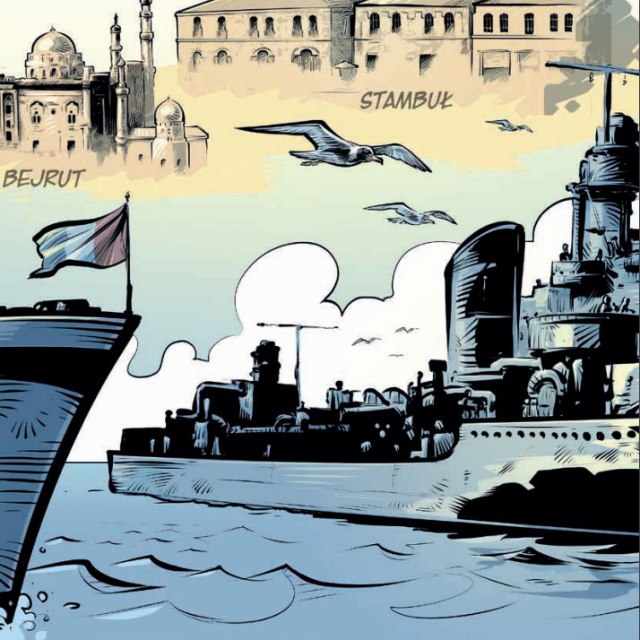
How the Polish gold train got stuck in French Africa during WWII
I just read about the Polish banker and economist Leon Barański (1895-1982), who worked as an expert and permanent representative of the World Bank in Ghana during 1962–1964. Then through his biography, I bumped into this epic story of how the Polish Bank tried to save its gold during World War Two, a process which Barański organized as the bank director. This was a truly geographical history: the plan was to evacuate the gold from France to the United States of America.
Plotting the semiperipheral empire: Hungarian imperialist imaginaries of Balkan landscapes, 1867–1948
Eastern Europe is the “black sheep” of postcolonial studies: its colonial experiences have been routinely missed out from the relentless focus on (post)colonial centres and peripheries. To be sure, postcolonial literature extended Orientalism as the […]
Tudománykommunikáció konferencia
Május 11-én pénteken előadtam a Tudománykommunikáció Kutatócsoport (Tud.Com) által a Budapesti Corvinus Egyetemen szervezett Tudománykommunikáció konferencián. Magyarországon ez volt az első ilyen témájú konferencia, és Pálinkás József, a Magyar Tudományos Akadémia volt elnöke és a NKFIH jelenlegi elnöke nyitotta meg. Az előadásom címe “A tudományos tudás földrajza és tudományunk eurocentrikussága” volt.
The shifting hegemonic relations between American and German human geography in light of the quantitative revolution, 1900-1970s
This research project looks at two intertwined processes in the history of North American and German geography from the early 20th century to the 1970s. First, the shifting hegemonic relations between “theory-importer” United States and […]

The Ghana Job: Opening Socialist Hungary to the “Developing World”
17 April 5:30 PM Seminar Room Department of Sociology Rutgers University 26 Nichol Ave New Brunswick, NJ 08901 facebook event Why was Hungary interested in the decolonized “developing world”? What does this episode of Eastern […]

Tracing the Global History of the Quantitative Revolution: The Transnational History of Central Place Theory
My book project is about the global histories of the “quantitative revolution” in geography. The quantitative revolution has been an epochal textbook chapter in geography’s canonical history, when the discipline transformed into a rigorous social science backed by predictive mathematical methods in the early Cold War. An iconic scientific concept of this quantitative movement, most notably related to Walter Christaller (1933) and August Lösch (1939), was central place theory (CPT). With the globalization of the quantitative revolution after its emergence from the Second World War in the United States, location theories such as CPT became widespread in urban and regional planning across the world. How did quantitative spatial analysis and planning develop in different parts of the world? In what different geographical contexts were location theories like CPT read, reinterpreted, applied, and mobilized? How were these often very different contexts connected? This book offers to fill this significant gap in geography’s twentieth century global history by deconstructing the mainstream Anglo-American narrative and tracing the quantitative revolution through the circulation and local applications of CPT in the “Second” and “Third” worlds and into the pre-Cold War era.
Why is the decolonization of the history of modern science and technology important in Eastern Europe?
Why is the decolonization of the history of modern science and technology important? So that we can understand why Francis Bacon’s iconic title page image of a European caravella navigating through the pillars of Hercules in his book Instauratio Magna (Great Instauration, 1620) or Novum Organum Scientiarum (“new instrument of science”), which indicated the new program for modern empirical (colonial) scientific development, was actually taken from Andrés García de Céspedes’s book, Regimiento de navegación (Madrid, 1606). This shows the Northwestern European (Dutch, British, German), Protestant hegemonic shift, which stigmatized the downfall of “luxurious”, “inefficient”, “rapacious”, “unindustrialized”, “state-led capitalist” Spain, the Iberian or Southwestern European imperial-colonial project, against the “industrial revolution” and “scientific revolution” of the Northerners, the latter of which the image became a symbol. The deconstruction of this narrative is important in revealing the concealed global histories of colonial scientific and technological development, which was partly a precondition for the development in the new hegemonic centre in Europe. The South American decolonialist approach might be an important influence in decolonizing Eastern European knowledge production, since the Northwestern-Atlantic-Protestant narrative of scientific development, largely present in social scientists’ work such as Max Weber or Karl Marx, was dominantly diffused in Eastern Europe as our Eurocentric understanding of global scientific and economic development. I was educated according to this narrative already in primary school.
 Zoltán Ginelli